A faculty-guided research project became a conference presentation — and a stepping stone toward graduate study.
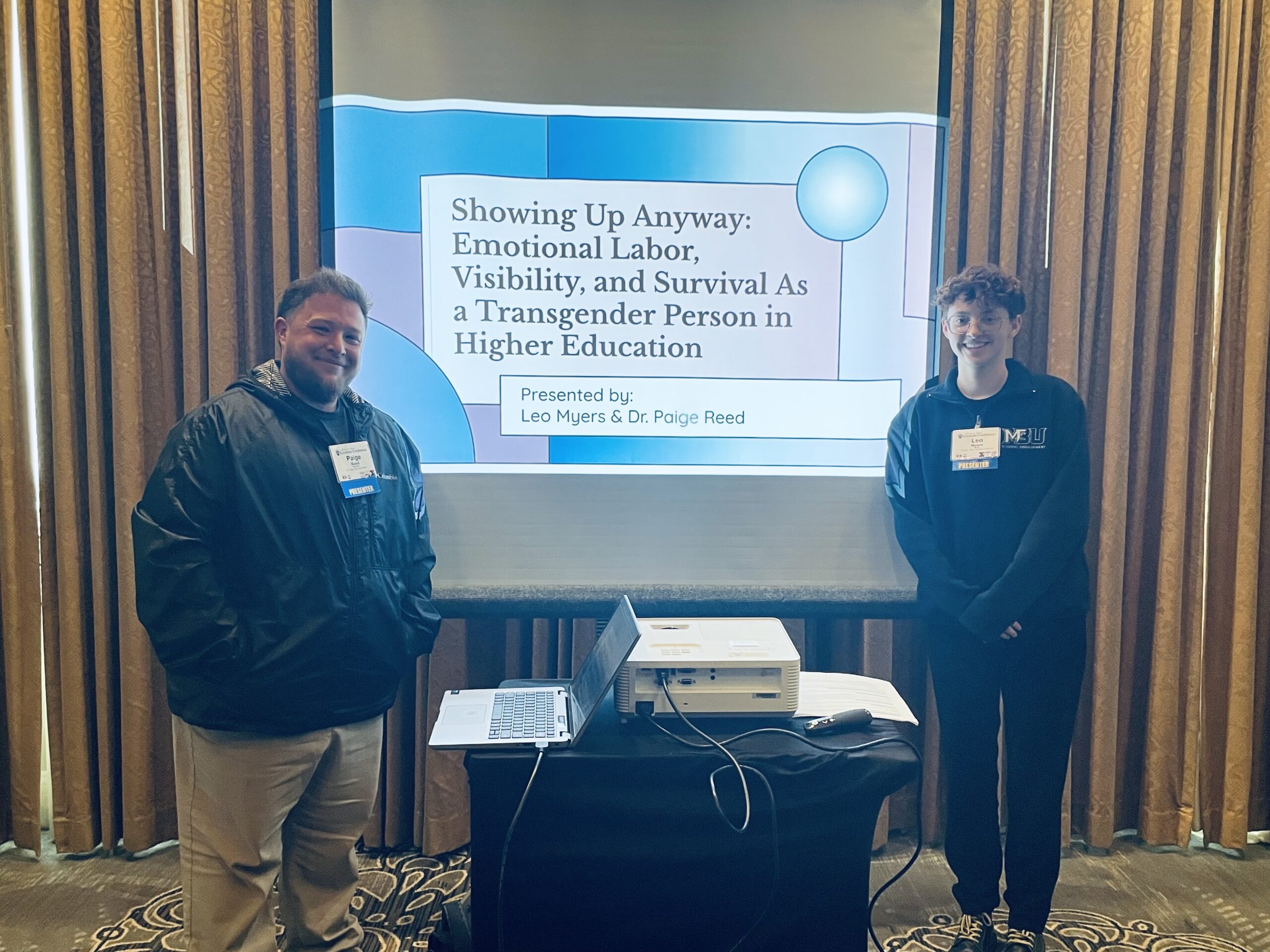
For Leo Myers ‘27, an unexpected scheduling challenge turned into a defining academic opportunity, one that led him beyond the classroom and onto the stage at a national conference.
An English major with minors in criminal justice and sexuality and gender studies (SGS), Myers came to MBU still exploring his academic direction. Now, he’s already looking ahead to graduate school, fueled in part by a recent experience conducting original research and presenting alongside faculty mentor Dr. Paige Reed at the Keystone Conference in Harrisburg, PA.
Turning a Challenge into an Opportunity
Myers’ journey to the conference began with a practical problem: he needed an additional SGS course to stay on track for early graduation, but none were available that he hadn’t already taken.
That’s when Dr. Abby Wightman and Reed suggested an alternative: a direct inquiry course, allowing Myers to design and pursue an independent research project.
“The course on my transcript is called ‘Transgender Research and Advocacy,’” Myers said. “Dr. Reed helped me create a plan for research, including current context, political context, and statistics about visibility.”
Together, they identified several potential projects, ultimately focusing on a conference presentation exploring what it means to be transgender in higher education, from both student and faculty perspectives.
Researching Visibility and Its Impact
At the heart of Myers’ work was the concept of visibility — how openly transgender individuals are perceived in academic environments, and how that visibility can affect their experiences.
“If you’re highly visible, that means people are aware of your identity,” Myers explained. “If you’re less visible, it can mean that people are less aware or are totally unaware of your trans identity.”
Through independent research and collaboration with Reed, Myers examined how visibility intersects with risk, performance, and burnout. In his presentation, he explored how shifting social and political climates can influence decisions about self-disclosure.
“Visibility can also stem from risk assessment,” he said. “Individuals at universities that have become less accepting might scale down their visibility to avoid risk. Professors might be asking themselves, ‘How much of myself can I share with my students?’”
From Research to Presentation
The culmination of Myers’ direct inquiry course was a joint presentation at the Keystone Conference, a gathering focused on issues affecting transgender communities.
Despite his preparation, the experience pushed him outside his comfort zone.
“Oh yeah, I was nervous,” Myers said. “I wrote the majority of a 10-page script for us to read from. Dr. Reed added their own information and edited what I wrote.”
The pair structured their session to include a 40-minute presentation followed by time for discussion, a format that allowed them to engage directly with attendees.
For Myers, the experience was both academically and personally transformative.
“I learned how to do meaningful research,” he said. “It was so much more personal, and it helped me learn how to navigate sources and legitimacy. This feels like a really good stepping stone for my thesis next year.”
Mentorship and Growth
Central to Myers’ experience was his relationship with Reed, whose mentorship helped guide both the research process and the presentation itself.
“I have a great personal relationship with Dr. Reed, and I’m so grateful to them for letting me do this direct inquiry,” Myers said. “I learned a lot about self-confidence, since this was a difficult topic for both of us. But it was really nice to connect with someone while we worked on it.”
That collaboration reflects a hallmark of the MBU experience: close faculty-student partnerships that extend learning beyond the classroom and into real-world impact.
Looking Ahead
Myers’ time at MBU has been marked by both academic exploration and advocacy. As a resident assistant for the Creativity and Culture neighborhood and an active member of honor societies like Sigma Tau Delta and Alpha Mu Gamma, he’s built a strong sense of community on campus.
He’s also engaged in efforts to support and advocate for inclusive programming, including participating in student-led efforts to preserve the SGS minor.
Now, with graduate school on the horizon, Myers is thinking about how to carry this work forward.
“I want to study sociology in graduate school,” he said. “I want to do this type of research more in the future, and this whole project showed me that.”
At the core of his academic and personal journey is a commitment to visibility, not just as a research topic, but as a guiding principle.
“I know that wherever I end up, identity is going to be important,” Myers said. “It’s important to me that people know they’re allowed to be visible. I think trans people need to be normalized and represented, even if it doesn’t always have to be at the forefront of people’s identities.”
For Myers, what began as a scheduling workaround became something much more: a powerful example of how academic curiosity, mentorship, and lived experience can come together to create meaningful scholarship.