On the last day of an ecology field trip, Brooklyn Rolph ’28 spotted a stone spear point estimated at 3,000 to 4,500 years old, now in the possession of the state.
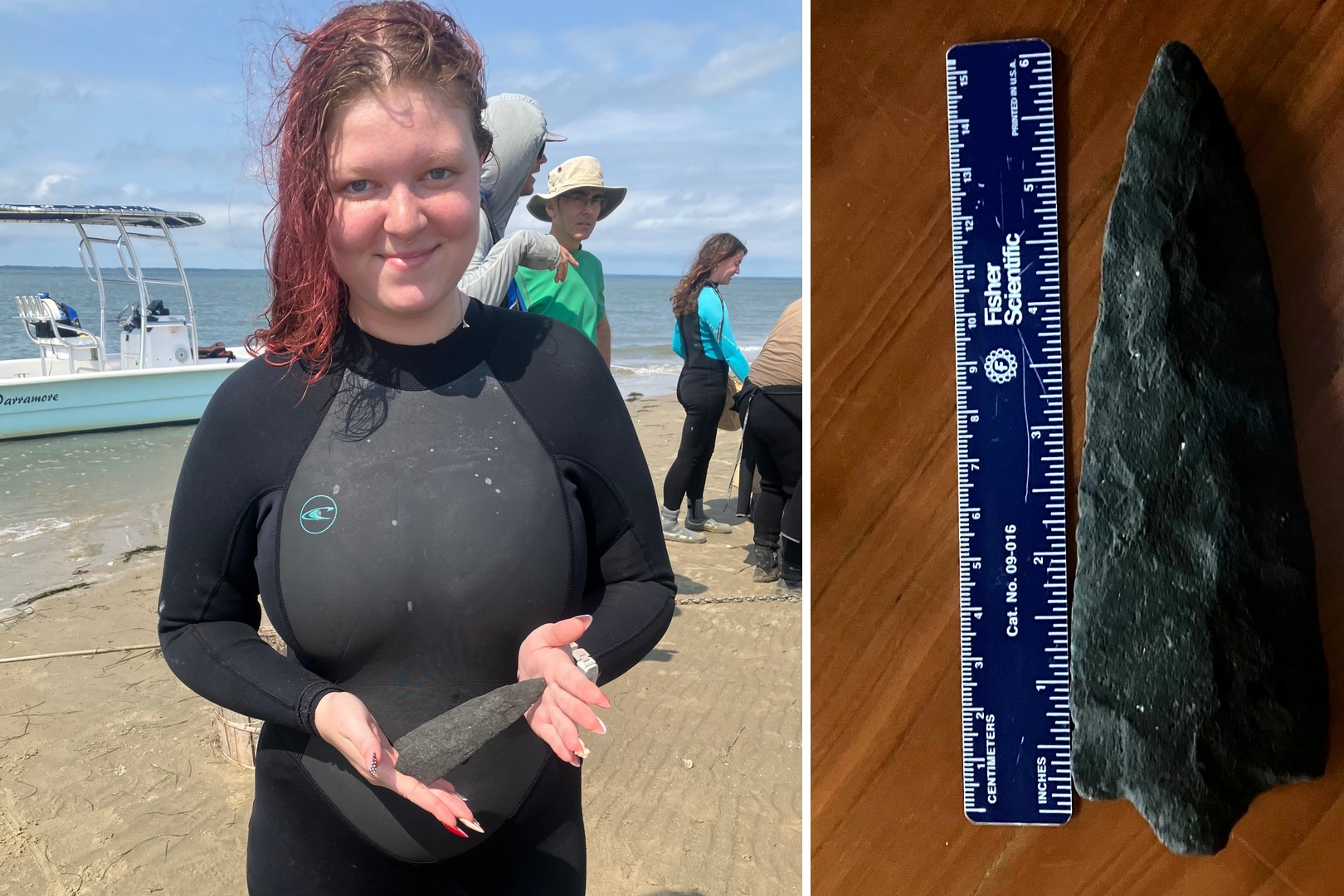
Brooklyn Rolph ’28 had a few minutes to explore the island. She spent them looking for shark teeth.
What she found instead was a stone spear point about 6 inches long and 3,000 to 4,500 years old. According to Rolph, the archaeologist who examined it said he had never seen one in such good condition.
Rolph, a biology major from Hampton, Virginia, found the point on Sept. 21. It was the last full day of a four-day field trip for her ecology course, BIOL 245, to the University of Virginia’s Anheuser-Busch Coastal Research Center on Virginia’s Eastern Shore. Four of Mary Baldwin’s biology faculty led the trip: Dr. Paul Callo, Dr. Adam Seroka, Dr. Rebecca Haberman, and Kadrin Anderson.
How It Happened
A narrow window. The find almost didn’t happen. Until the wind settled down, the class wasn’t sure it could take the boats out at all. After a morning in wetsuits, wading through a seagrass bed and collecting specimens, the tides and currents allowed only 35 to 40 minutes on a nearby barrier island. Students had just a few minutes after lunch to explore.
“The set of circumstances that came together that made this possible is quite unbelievable,” Dr. Callo said.
Eyes tuned for something pointy. Rolph had found small shark teeth on a beach trip years earlier, and the shells covering the island looked promising.
“I’m over here looking for shark teeth, because there’s so many shells, and I’m like, I feel like this would be a great spot to find shark teeth,” she said. “I already have the field of view that I’m looking for something pointy.”
The sprint. She spotted the point in the water at the edge of an inlet. Her timing mattered. “The tide was coming in, so the spear point was soon to be buried,” Dr. Callo said.
“I see it and I’m like, okay,” Rolph said. “And then I pick it up, and I literally sprint to Dr. Seroka, because I’m like, wow, this is so crazy.”
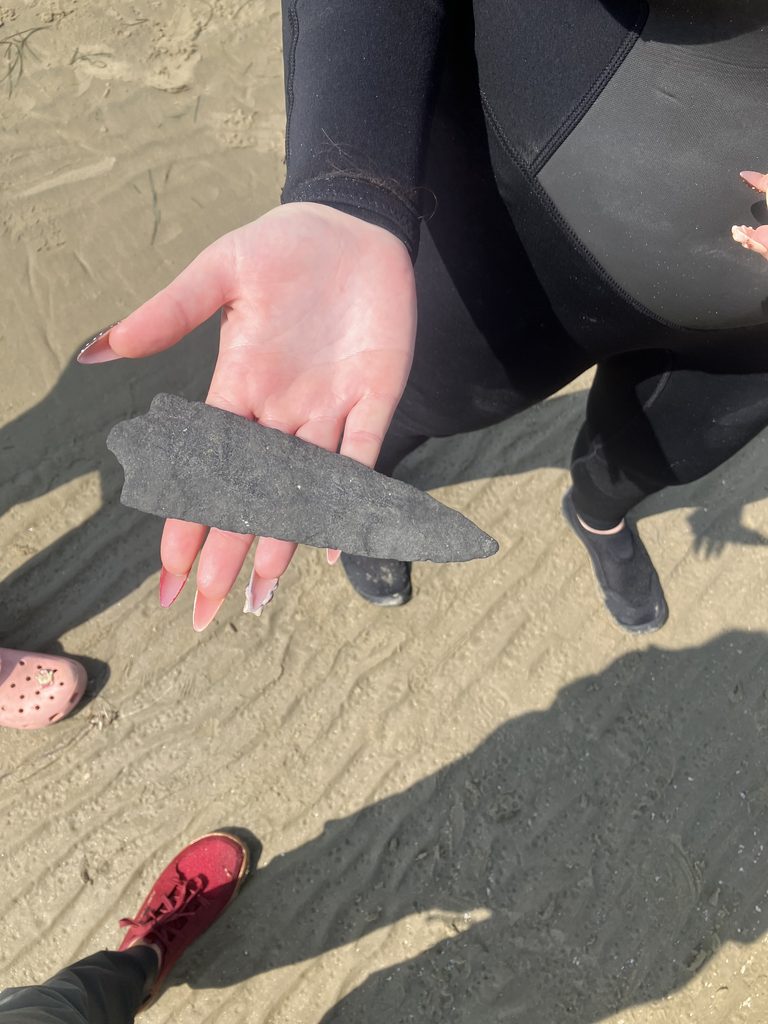
She stayed calm. Her professors didn’t.
Two friends nearby rushed over. “They’re all freaking out,” she said. “I feel like I’m the only one that’s not freaking out that much.”
Her professors were even more excited. “They were ecstatic,” Rolph said. “I think they were happier than I am.”
Dr. Callo said he was “truly at a loss for words” when she showed it to him. “I think I said, ‘What the … what the …,’” he said. He’s quick to add: “No f-bomb!”
For him, the moment was bigger than the object. “It is certainly awe-inspiring to see and touch something that was made by human hands thousands of years ago,” he said. “Brooklyn was probably the first person to see it and touch it in all of that time.”
The phone call. Dr. Callo warned Rolph she might not be able to keep the point. The island is part of a natural area preserve owned by the Virginia Department of Conservation and Recreation. Rolph showed the point to the research center’s site director, who made a call and came back with the answer: the point belonged to the state.
Rolph took that in stride, even when classmates were surprised by how easily she gave it up.
Later that day, at the state archaeologist’s request, staff from the Department of Conservation and Recreation collected the point from the research center’s bunkhouse. They took it to the Virginia Department of Historic Resources for further study.
The Find at a Glance
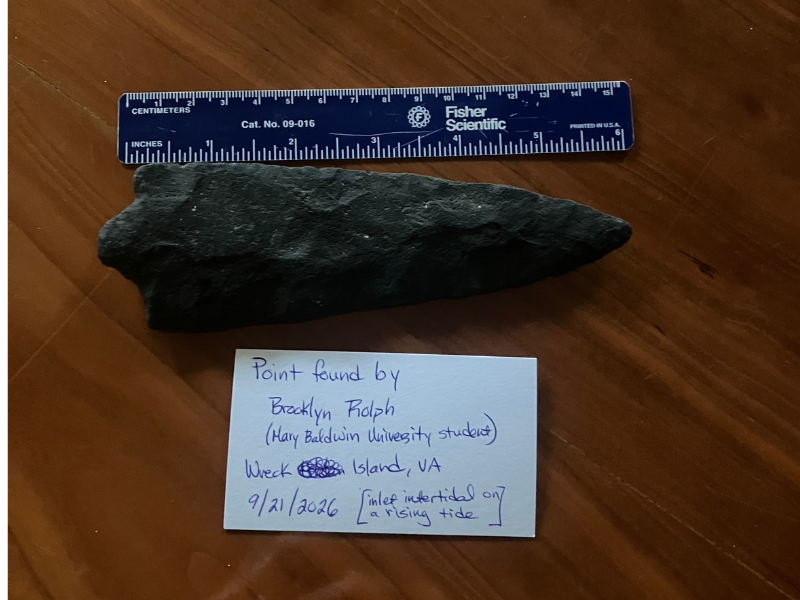
Caption: The point measures about 6 inches. State archaeologists identified it as a Lehigh/Koens-Crispin point.
| What | Lehigh/Koens-Crispin spear point |
| Age | 3,000 to 4,500 years |
| Size | About 6 inches |
| Found | Sept. 21, 2026, in an intertidal inlet on a rising tide |
| Where | A barrier island on Virginia’s Eastern Shore |
| Found by | Brooklyn Rolph ’28, biology major |
| Now held by | Virginia Department of Historic Resources |
Out of the Classroom
The spear point was a surprise. The rest of the trip went as designed: four days of hands-on ecology, with faculty working alongside students in the field. The department makes the trip every year, and Dr. Callo credits the research center’s staff, who he said “have been instrumental in making this trip an annual success.”
“I think the goal was to just have a field understanding of the relationships between the animals and the plants and the ecosystem,” Rolph said. “To go out and see it, instead of just talking about it in a classroom.”
Dr. Callo described the goal much the same way. “The primary goal is to allow students to experience and explore coastal ecosystems,” he said. “They have the opportunity to see an environment that many have never experienced before, and they can apply the investigative tools they learned in previous labs to a completely new environment.”
Each student designed and ran an experiment. Rolph studied water turbidity, measuring how quickly filter feeders like oysters and sea squirts clear murky water. “I learned how to execute an experiment on my own, which I haven’t really done before,” she said.
“Ultimately, I want them to appreciate the place they are in as fully as possible from both a personal and scientific perspective,” Dr. Callo said. “This is something we could never do with just a traditional three-hour-long lab.”
A New Vibe in Class
The trip changed the class, too. Rolph said her classmates barely spoke to each other before they left. “It was not a social kind of class,” she said. “But it was good during the trip. We all did end up talking to each other.”
It also changed how she sees her professors. “It was weird at first, because of course they’re [just] professors,” she said. “But as bad as it sounds, it helps you see them as people.”
Rolph described herself as someone who gets nervous talking to professors. “That helps, though,” she said. “Making it feel more comfortable to reach out to them or talk to them on your own time and not be afraid of it.”
The view works both ways. Dr. Callo said faculty keep some professional distance on the trip, but time outside the classroom still gives him “a window into their personalities where I can learn things about them that are not obvious during the regular school week.”
Rolph came in planning a career in medicine, and she still considers herself “a cell biology person.” But the trip opened another door. “It made me realize that I enjoy research and I enjoy the field work,” she said.
Any regrets?
Her friends all wanted to know whether she got paid for the find. She didn’t. Some of them joked she should have kept quiet and kept the point.
Rolph says she made the right call. “I’m like, no,” she said, “because that’s how you get cursed!”