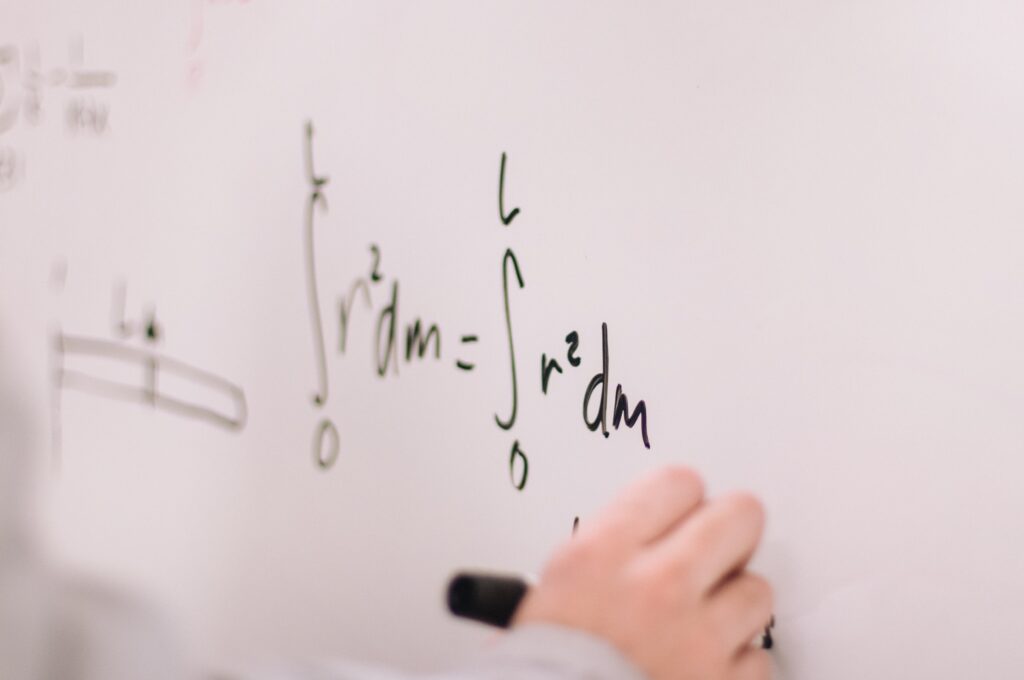

Mathematics (BA/BS)
Harness the infinite potential of numbers.
Considering a career in data science, AI development, technology, education, business, law school, or medical school? The mathematics major from Mary Baldwin can open doors. Our faculty are deeply committed to teaching and to the academic and personal growth of each student. Our program is designed to give you individualized attention and hands-on research opportunities. From classes that explore the foundations of abstract mathematics and logic for graduate school to courses that engage dynamic industrial applications, the mathematics major at Mary Baldwin has something for everyone.
- Time to Completion4 years
- FormatOn Campus
- Degree(s)Bachelor of Arts,
Bachelor of Science - MinorMathematics, Math Education
Next steps


Why study math at Mary Baldwin?
Mathematics opens up cognitive pathways of critical and analytic thinking. Not only is the mathematics major applicable to a wide variety of careers in industry, but mathematics majors hold the highest rate of admission to medical school and a higher-than-average rate of admission into law school.
By studying mathematics at Mary Baldwin, you get the benefits of a high-quality liberal arts education paired with the skills needed to succeed in a STEM career. Our smaller class sizes and focused courses mean that you never get lost in the crowd, but instead receive the individualized attention and support needed to build a strong foundation for a professional career.
Next steps
Pure mathematics is, in its way, the poetry of logical ideas.
Albert Einstein
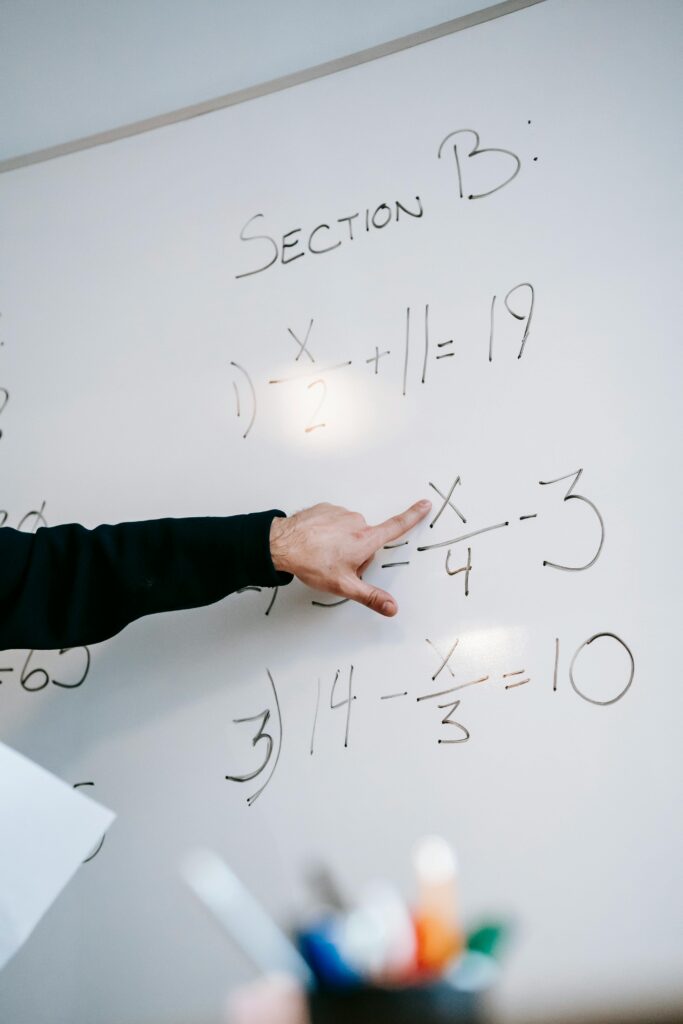
Connecting mathematics to the world beyond MBU
Mathematics majors have the opportunity to participate in conferences, including the Shenandoah Undergraduate Mathematics and Statistics Conference at James Madison University, and Research Experiences for Undergraduates (REU) at various partner colleges.
Seniors also complete a capstone project that relates their work to an industry or subject of potential graduate study, and our Math Club presents opportunities for civic engagement on campus and beyond.
Students love our courses
Don’t expect a tired lecture at Mary Baldwin. Our courses are high quality and practical.
Here we cover the basic concepts of differential calculus and its applications — including limits, continuity, differentiation, chain rule, mean-value theorem, optimization problems, antiderivatives, and transcendental functions. Required for math majors and recommended for sciences and economics majors.
An introduction to the techniques of theoretical mathematics. Explore logic, truth tables, deductive proof, algorithms, algebraic structures, discrete probability, counting methods, relations, graph theory, and the principle of mathematical induction. Many topics have substantial applications to computer science.
Develops the theory of vector spaces and its underlying relevance to matrices and systems of linear equations. Topics include the vector space Rn, abstract vector spaces, systems of linear equations, linear transformations, eigenvectors, and eigenvalues. The goal is to provide a bridge from the intuitive developments of lower level courses to more rigorous abstract courses in mathematics.

Explore the Neighborhood
This major is part of the Health & Science Neighborhood. Neighbors live together their first year, study and take classes together, and enjoy special curated activities.
Our Faculty
Our faculty are deeply invested in the academic and professional success of our students. With a passion for teaching, these educators go above and beyond, providing mentorship, personalized guidance, and exciting hands-on research opportunities.
Cost & Financial Aid
A great education is worth it. Mary Baldwin offers generous financial aid packages and a broad range of scholarships to help you bring your aspirations to life.
MBU helps you fast-track your path to a bachelor’s degree with the opportunity to transfer up to 18 credits (6 courses) through direct course equivalents from the Virginia Community Colleges System.
A bachelor’s degree requires 120 credit hours of study.