The longtime professor of Shakespeare and Performance is now the Inaugural Folger Chair in Shakespeare Studies.
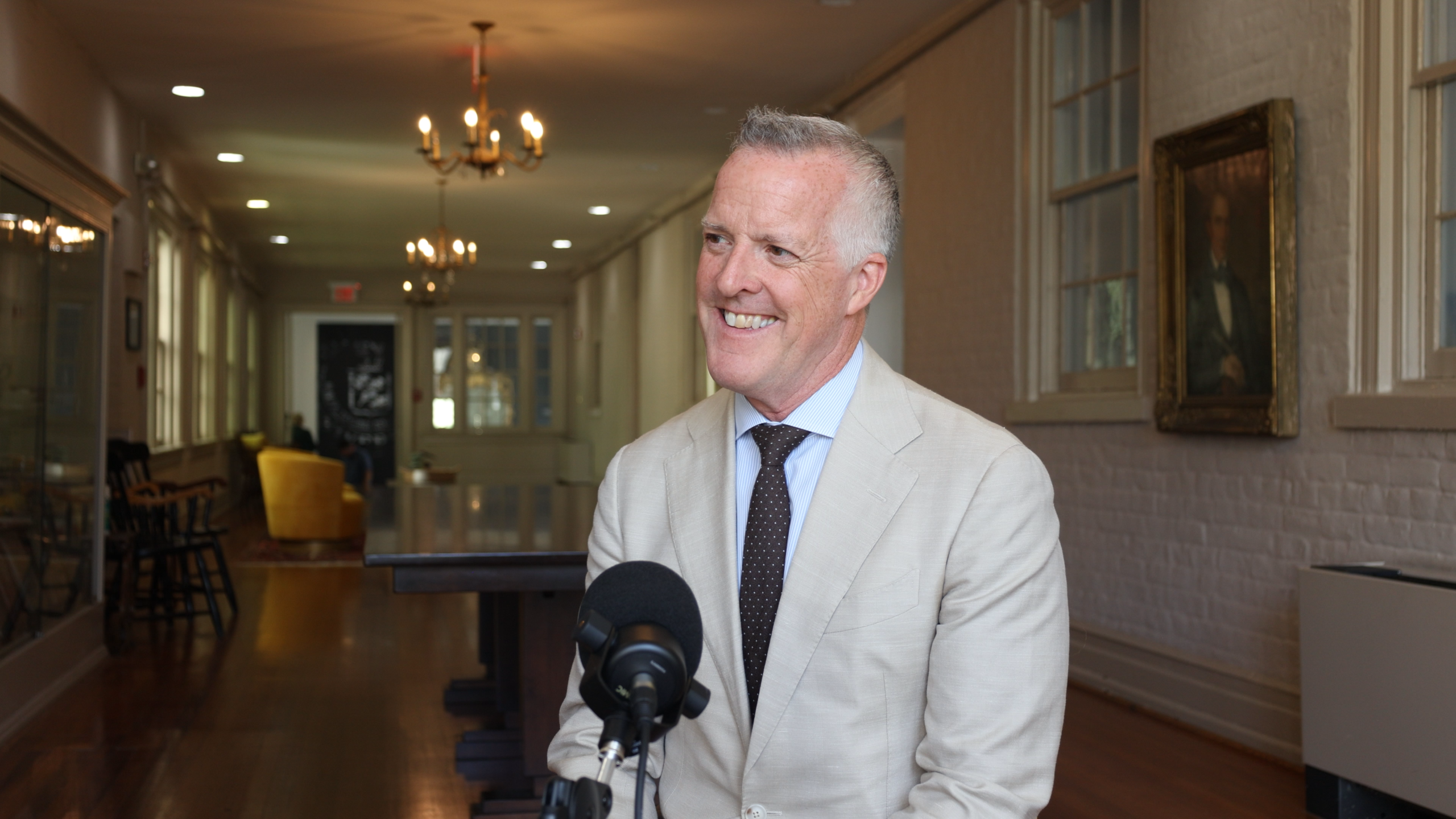
Dr. Paul Menzer, professor of Shakespeare and Performance at Mary Baldwin University, was recently named the inaugural Folger Chair in Shakespeare Studies at the Folger Shakespeare Library in Washington, D.C. The appointment gives Menzer — who has spent recent years in administrative roles as dean, provost, and executive director — a year of dedicated research time and access to the world’s largest Shakespeare collection.
His project, “Shakespeare’s Enemies,” is the first book-length study of the writers, artists, and public figures who couldn’t stand Shakespeare — a list that runs from Ben Jonson and Voltaire to Tolstoy, Tolkien, James Baldwin, and George Bernard Shaw. Keith Taylor, a graduate of MBU’s Shakespeare and Performance program, sat down with Menzer to talk about literary animosity, the Folger’s vaults, and why a little skepticism might be exactly what Shakespeare students need. The conversation has been lightly edited for clarity.
Transcript
Keith Taylor: Hello, I’m Keith Taylor, and I’m glad to have you listening as I speak with Dr. Paul Menzer, professor of Shakespeare and Performance at Mary Baldwin University, and recently announced the inaugural Folger Chair in Shakespeare Studies with the Folger Shakespeare Library in Washington, D.C. Paul, welcome, and thanks for joining me.
Dr. Paul Menzer: Thank you, Keith. Anytime. Great to be with one of our most honored and cherished graduates of the Shakespeare and Performance program.
Taylor: I appreciate it. Diving right in — the Folger Chair is described as being for scholars who’ve spent years in administrative roles and are getting research time back. You’ve been dean, provost, executive director. What does it actually feel like to have a year where the job is just: think about Shakespeare’s enemies?
Menzer: A great question. First of all, it’s an enormous relief to have this time back. One of the things you do as a university administrator — and even within your field — is you try to build out research ecosystems for other people. Not just the graduate students here at Mary Baldwin, but people in your field and in other disciplines as well. One of the primary functions of the provost, I think, is to make research opportunities available for faculty and students. Which is a way of saying, I’ve spent three to five of my last years trying to convene opportunities for other people to have the time to pursue their research. So what a gift to have some back for myself. I’ve tried to keep a hand in publishing and scholarship, but it is difficult to do while you’re holding down a full-time job.
Taylor: And to tell the truth, you’ve been pretty prolific for the workload you’ve had outside of research.
Menzer: Because I’m very facile. But it’s been a tantalizing experience these last few years.
Taylor: Can you give me the elevator pitch? Your project is entitled Shakespeare’s Enemies.
Menzer: So Shakespeare’s Enemies is a project that takes on, for the first time really as a book-length project, the history of Shakespearean animus — by which I mean those individuals, artists, creators, educators, students, popular public figures who just really don’t like Shakespeare.
There’s actually been surprisingly little attention paid to this. But as it turns out, many of our most accomplished and famous writers really didn’t like Shakespeare — from Ben Jonson to Voltaire to Wittgenstein to Tolstoy, even to J.R.R. Tolkien, who, kind of surprisingly, wasn’t really a big fan of Shakespeare. He thought Shakespeare’s treatment of elves in particular was really just beyond the pale. Tolkien, as a fantasist, really took umbrage at Shakespeare’s treatment of fairies and elves.
Up to, I think, more recent figures like James Baldwin. James Baldwin, one of America’s most beautiful and original writers, really struggled with Shakespeare. As a Black American man, he had a great deal of ambivalence about Shakespeare — and I’m fascinated by this concept. In 1964, Baldwin wrote an essay called “Why I Stopped Hating Shakespeare,” and he wrote about his experience of feeling — particularly from his perspective — that Shakespeare just occupied too much space as a writer. Baldwin also said, “I do not think that there is any writer who has not, at one point or another, absolutely hated Shakespeare.”
So I’m really interested in tracing and treating, across the years, how that has evolved and changed. And because we’re doing a podcast, I’m thinking a little bit about Ira Glass —
Taylor: Sure. For the uninitiated, the famed host of the NPR podcast This American Life.
Menzer: One of the progenitors of the podcast medium, right. Very famous — to the extent that a podcaster can be famous. He has millions of followers; they all carry tote bags. So it’s a particular kind of celebrity we’re talking about. But in 2014, he created a bit of a dust-up when he’d gone to a production of King Lear and then tweeted out that he didn’t get it — that Shakespeare was totally unrelatable. And that created a whirlwind of responses. But it actually signaled a particular kind of resistance to Shakespeare that I’m really interested in.
So I want to think about — from Shakespeare’s contemporaries like Ben Jonson and Robert Greene, all the way up to a figure like Ira Glass — what is the resistance to Shakespeare? What is the animosity even potentially about? And one of my working theses, as I’m just beginning this project, is that there is a history, but not a tradition, of Shakespearean animus. The distinction I mean by that is: there’s a history across the last 400-plus years of figures who have set themselves in opposition to Shakespeare, but there’s no tradition of people doing it — by which I mean that everybody who sets themselves in opposition to Shakespeare thinks that they’re the first one.
Taylor: Yes — they don’t recognize a mantle being passed.
Menzer: Precisely. Because it’s an iconoclastic, idiosyncratic position to take, it kind of relies upon imagining that you’re the only one.
Taylor: To what extent does a writer — or a canon — like Shakespeare need haters to become as canonical as it is?
Menzer: That’s absolutely a great question, because one of the working theses I’ve had — though I have a little bit of skepticism around it — is: to what extent is Shakespearean animosity constitutive of his greatness?
Taylor: That’s what I’m wondering — are the enemies, the haters, the engine?
Menzer: It’s interesting. Does the hatred constitute his greatness? Is it like a regenerative brake in a car — where you brake, and that only gives more fuel and power to the car? Does Shakespeare require this animosity to constitute his greatness? I think there’s something to that that I want to explore more. But I want to find out a little bit more about it — I’m not positive yet that I believe my own thesis.
Taylor: You’ll have access in this position to the Folger’s collection — the largest Shakespeare collection in the world. Does this afford you access to any specific document or antique you already have your eyes set on?
Menzer: Absolutely. The Folger Shakespeare Library in D.C. is the world’s largest repository of Shakespeare — from their 82 First Folios through a collection of art objects that have been produced about, beyond, and around Shakespeare’s creation. And one of the things the Folger has — and people really don’t look at it — is a lot of original manuscripts. They have letters, they have diaries, they have journals. These are materials that are not otherwise accessible. A lot of these things have not been digitized, so they’re only available in person, given the kind of time afforded to someone in this role.
So, for instance, George Bernard Shaw — a writer not much in evidence today, not very popular today, and not a lover of Shakespeare —
Taylor: Not a lover of Shakespeare — perhaps the greatest of all the Shakespeare haters.
Menzer: Yes, right. George Bernard Shaw is the one who coined the term “Bardolatry” — the worship of Shakespeare — which is something Shaw was really skeptical of. Shaw had a kind of edifice complex: he never saw a tower he didn’t want to topple. He talked about Shakespeare as the Bastille of literature that needed to be stormed and broken down. He had an investment in a particular kind of psychological realism that he found Shakespeare, as a playwright, wanting in.
But to get back to your question: the Folger holds some original manuscripts in Shaw’s hand, so I’ll have access to that kind of material. And there are a lot of other instances like that — unique Shakespearean objects, art objects, that only the Folger has, and I’ll have access to them.
Taylor: Just from those vivid descriptions — the Bastille, the tearing down of the edifice — it feels like if anyone had a sense of taking on the mantle of Shakespeare-haterism, George Bernard Shaw might be the closest we’ve come.
Menzer: He’s really a signal figure in this study. I’m going to give him his own chapter called — wait for it — “Pshaw,” just to signal his skepticism.
He’s a fascinating figure. He’s one of those figures who was born under Queen Victoria and lived until the advent of the pill. He lived forever, and he brackets two worlds — the world of Victorian England and a more modernist world. So he really is interesting, and his Shakespeare animosity bridged his entire career.
Taylor: Your chair at the Folger registers as another touch point in this ongoing relationship between the Folger Library and our own Shakespeare and Performance program here at Mary Baldwin University. What does it mean — for you, for our students, for the program — to see this relationship, this recognition of each other’s work in the field, continue to grow and build?
Menzer: Well, the first thing to say is that really any and every success I’ve had as an academic, as a scholar, as a writer, is because I’m here at Mary Baldwin — because I’ve been fortunate enough to be director of, and associated with, the Shakespeare and Performance program, and to get to work with incredible students like you and many hundreds of others over the last two decades of my life.
Being here in Staunton, in this Shakespeare community — both the Shakespeare and Performance program and the American Shakespeare Center — has provided the platform for the kind of curated, collaborative academic career that would not have been possible elsewhere. So all credit to Mary Baldwin, the Shakespeare and Performance program, and the American Shakespeare Center for my appointment to this role.
And while I’m giving credit — what this also allows me to do, in this more public-facing role, is continue to raise the profile of Mary Baldwin and the Shakespeare and Performance program: to explore more opportunities for our students to work with the Folger, to find ways to get them up to the collection and to get Folger folks down here. We have a long, abiding friendship with many of the people at the Folger, and this is really a fluorescence of that relationship. So I’m very touched and honored personally, but I think it’s an instance of recognition for Mary Baldwin and what we do here in this Shakespeare community.
Taylor: And I do appreciate these more formalized touch points — we had the gift of that beautiful sculpture just last year, and now this. I feel momentum building.
Menzer: Yeah. And again, many of our faculty work closely and often at the Folger, and we want to get more involved with what they do in their theatre operations. I was up in D.C. yesterday — the first day of my fellowship — meeting with the director of the Folger and talking about the theatrical programming there, and how what we do down here might be a part of that in the future.
Taylor: That’s exciting. Last question. You’ve mentored a ton of students who’ve gone on to do a lot of very different things with Shakespeare — teaching, performing, writing. Does thinking about Shakespeare’s enemies change how you think about that mentorship? Is there something useful in a student pushing back on Shakespeare — in you cultivating maybe some antagonism in your own students toward Shakespeare?
Menzer: That’s a fabulous question. I don’t want to cultivate animosity among students, but I do want to cultivate skepticism and critical engagement.
One of the things a number of writers have resisted in Shakespeare is just the sheer amount of space he takes up in the canon. A scholar once famously described the literary canon as very few books taking up a lot of space — and among those very few books is Shakespeare. Shakespeare really does crowd out a lot of other writers.
What I want our students always to engage with is the thing itself — not the penumbra of celebrity that surrounds Shakespeare. I want them to engage with Shakespeare and find their own reasons for connecting with it, not other people’s reasons. If students can cultivate a skepticism, maybe even an ambivalence — though not an antagonism — it allows them to look with their own eyes and discover what is meaningful for them, rather than just the reputation, or the received tradition that we must venerate this figure because he’s always been venerated.
If students come out on the other side of that experience with their appreciation of Shakespeare only enhanced, that’s a success. But they will have come through that experience tempered by their engagement with it on their own terms. And in terms of thinking about the history — not the tradition — of Shakespeare animosity, there are some touch points I want to share with our students. Look at some of these writers — whether it’s Wittgenstein, Tolstoy, Shaw, Voltaire — and Baldwin in the end. For Baldwin, these were kind of road-to-Damascus moments. Baldwin came to Shakespeare with some real skepticism, some real ambivalence. But he came to terms with Shakespeare ultimately — through his own exploration, his own engagement, and his own hard, cold critical thinking. And that’s what I want for our students.
Taylor: And I guess in this way, Shakespeare has just made eternal students of us all. There’s no end to it.
Menzer: There’s no end to it. It’s always literally too soon to say anything is timeless, right? However, the endurance of Shakespeare across 400-plus years means that it is a place where we can continue to invest our energies, engagement, and attention — to make ourselves better critical thinkers, make ourselves, I think, more empathetic, and ultimately better citizens.
Taylor: Well, it’s a really exciting project. I’m thrilled for you, thrilled for the future, thrilled to see what this research produces in the end. And I hope that people in the community will find time to make it up to D.C. for some of these engagements — and, in the end, I’m sure, another great book in the works. So thank you for joining me.
Menzer: My pleasure, Keith.